Peters
Women TalkingPeters, the bishop of Molotschna Colony, presides over a community in which religious authority and self-government shape the response to violence. He first considers confining the accused men, then calls in the police when their lives are endangered; he also makes women’s forgiveness a condition of remaining in the colony. His actions and explanations expose the strain between the community’s language of faith and the coercive choices made under its authority. Near the end, the narrator reveals that Peters is August Epp’s biological father, making Peters’s power inseparable from the family history that sent August away.
Identity and Authority
Peters’s standing is visible in both public decisions and ordinary arrangements. Molotschna is self-policed, and he initially plans to lock the accused men in a shed for decades. When their lives come under threat, he and the elders instead call the police and have the men taken to the city. The change is presented as a measure for the men’s safety, but it also marks the limits of a community attempting to administer justice internally while anger and retaliation are escalating.
Peters’s authority extends beyond the immediate crisis. After the men are imprisoned, the remaining men of the colony travel to the city to post bail, hoping the accused can return while awaiting trial. Peters tells the women that, once the men return, they will have the opportunity to forgive them; forgiveness will secure everyone’s place in heaven. If they refuse, he says, they must leave for an outside world they know nothing about. The women have only two days to organize their response. In this formulation, forgiveness is not simply a spiritual practice: Peters makes it the condition for belonging, placing the burden of preserving the community on those who have been harmed.
His authority also governs access to information and resources. After the assaults draw photographers from around the world to the co-op, Peters decrees that no one there is to speak with them. A newspaper clipping reaches the co-op by way of Heinz Gerbrandt, a blacksmith whose forge is nearby; Heinz later reports that Peters acknowledged its account of the men’s treatment. August also says Peters has had a telephone for years and plays games on it while the other men work in the fields. These details complicate the image of a leader governing a secluded community: Peters can control what the colony says to outsiders while possessing access to a technology the other men do not have.
Faith, Violence, and Public Explanations
Peters’s handling of Mina Friesen’s death is one of the starkest tests of his authority. After Neitje Friesen is attacked, Peters first tells Mina that Satan was responsible and that the attack is punishment from God. He then says that Mina invented it, using the idea of a “wild female imagination” to dismiss her account. Mina challenges the contradiction between those explanations. She later dies by suicide, and Peters tells the colony that she died from ammonia fumes while cleaning the yearling shed. The women dispute that account and preserve what they know of the events, while the public explanation protects the institution from acknowledging the circumstances that preceded her death.
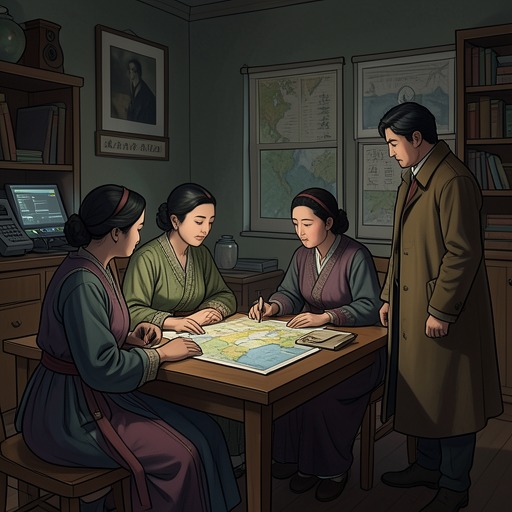
This episode sits uneasily beside Peters’s appeal to forgiveness as a route to heaven. Rather than offering a consistent account of what happened to Mina and Neitje, he supplies incompatible explanations and then gives the colony a different cause of death. The contrast is not merely between private grief and public speech: it shows who has the authority to define an event, whose testimony is treated as credible, and how a religious vocabulary can be used to assign blame to women. The women’s meeting offers a counter-record, assembling their knowledge into a shared account rather than accepting Peters’s version as final.
The women also reconsider what their faith requires. Agata argues that remaining would place them in the path of further violence and could turn the colony into a battlefield; leaving, she says, better preserves pacifism, love, and forgiveness. Ona points out that the women cannot read the Bible and that their understanding of wives’ submission comes through what their husbands have told them the Bible commands. These arguments do not establish that Peters personally authored every rule the women question. They do, however, place his ultimatum within a wider structure in which male authority interprets scripture and women are expected to bear the consequences. The women’s decision to leave thus contests his power without simply abandoning the faith he invokes.
August Epp and the Hidden Family History
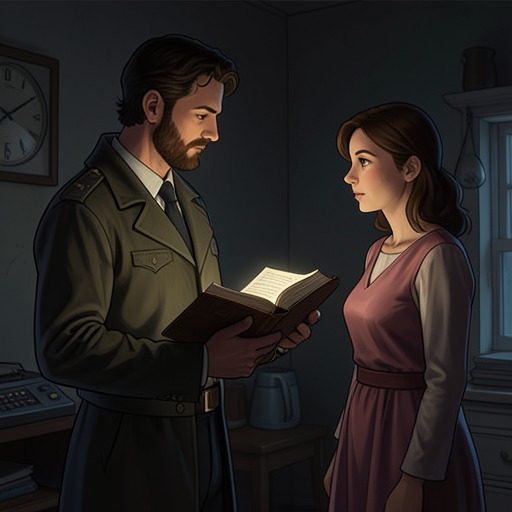
Peters’s relationship with August first appears through a negotiation over August’s readmission to the colony. Peters is described wearing tall black boots like those his own father once wore. He offers August membership on conditions: August must renounce his parents before the elders, accept baptism, and teach the boys basic English and simple mathematics in exchange for shelter in a shed and three meals a day. August agrees to be baptized and teach, but refuses to renounce his parents. Peters accepts the refusal. The narration suggests two possible reasons without settling between them: the colony needs the boys to learn accounting, or Peters is unsettled by how much August resembles his father.
The late disclosure makes that resemblance more than a passing observation. August is Peters’s son, and the account of August’s exile is revised accordingly. His parents were not sent away for the reasons the colony might publicly associate with them: his father’s photographs of paintings by Michelangelo or his mother’s secret school for girls. Instead, August says, they were sent away when he was twelve and beginning to approach adulthood, because he looked remarkably like Peters. To Peters, the boy had become a symbol of shame, violence, unacknowledged sin, and the failure of the Mennonite experiment. The leader who can decide who belongs in the colony had also helped remove his own child from it.
That history sharpens the meaning of Peters’s demand that August renounce his parents as the price of readmission. August refuses, and Peters nevertheless allows him to stay; the compromise offers shelter but does not erase the original expulsion or explain it openly. In the closing exchange, Ona tells August that she has prayed for him to find God’s grace and sees him as a physical reminder of goodness, hope, and life after violence. Her words refer to his mother and father, including Peters, whom she identifies as August’s biological father rather than the man who raised him and later disappeared. Peters’s hidden paternity therefore enters the story through another character’s act of care, not through a confession from Peters himself.
Narrative Role and Significance
Peters is not presented only as an individual antagonist or as the source of every rule in Molotschna. He is a central representative of a system in which the elders, husbands, and religious authorities shape the boundaries of acceptable speech, belief, and belonging. The evidence gives him direct responsibility for important decisions: calling the police, imposing the forgiveness-or-expulsion choice, restricting contact with reporters, and supplying the account of Mina’s death. Other claims, especially those about biblical submission, are voiced by the women as descriptions of the colony’s broader male authority and should not be mistaken for words Peters is shown speaking himself.
His narrative significance rests in the gap between his formal authority and the truths that authority cannot contain. Women preserve knowledge that his public explanations suppress; they interpret pacifism as a reason to leave rather than submit to a coerced reconciliation; and August’s resemblance to Peters turns a hidden family relation into evidence of the colony’s unacknowledged history. By the end, Peters remains powerful, but the account has made that power legible: it can regulate membership and public narrative, yet it cannot make the women’s testimony or August’s parentage disappear.